 By Meghna Sharma
Gold has traditionally played an important role in Indian households, serving both as a store of value and as jewellery used for weddings, festivals and other occasions. For investors, however, there is an important distinction between buying physical gold bullion and buying gold jewellery.
Gold bullion generally refers to investment-oriented gold in the form of bars or coins, while jewellery is primarily designed for personal use and can also contain significant making charges and design-related costs. Both provide exposure to the price of gold, but the actual investment experience can be very different.
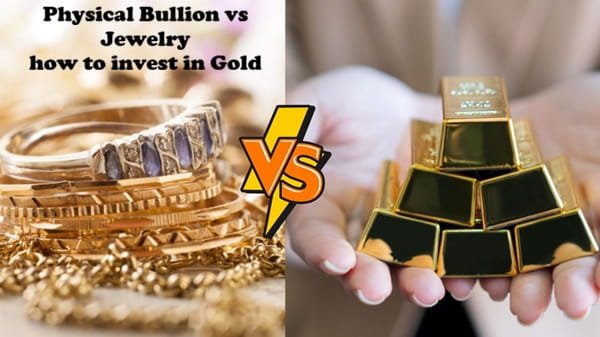
For someone investing primarily for financial returns, bullion is generally more directly linked to the value of the underlying gold. Jewellery may make more sense when the buyer wants both gold ownership and personal use.
What Is Physical Gold Bullion?
Physical bullion includes gold bars and coins purchased mainly for their precious-metal content.
The value of bullion is primarily determined by:
- Gold purity
- Weight
- Prevailing gold price
- Dealer premium
- Taxes and transaction costs
Gold bullion can be available in different weights and purities. BIS standards include 24-carat bullion grades such as 995 and 999 fineness. BIS also maintains a framework for licensed refineries and mints producing gold bullion and coins.
For an investor, the advantage is relatively straightforward valuation. A 10-gram high-purity gold bar, for example, is primarily valued according to its gold content rather than craftsmanship or design.
What Is Gold Jewellery?
Gold jewellery includes necklaces, rings, bracelets, bangles, earrings and other ornaments.
Unlike bullion, jewellery has two components of value:
- Intrinsic gold value
- Value associated with manufacturing, craftsmanship and design
The second component can make jewellery substantially more expensive than the value of the gold contained in it.
Jewellery can also have different purity levels. Common examples include 22K916 and 18K750, where the numerical fineness indicates the proportion of gold in the alloy.
For jewellery sold in applicable mandatory-hallmarking areas, BIS requires specified hallmarking standards. Hallmarked jewellery carries the BIS Standard Mark, purity/fineness marking and a six-digit HUID. Consumers can use the BIS Care App’s “Verify HUID” feature to check the HUID.
Bullion vs Jewellery: Main Difference
The biggest difference is the relationship between the purchase price and the underlying gold value.
With bullion, the purchase price generally consists mainly of the value of the gold plus applicable taxes and the seller’s premium.
With jewellery, the buyer can also pay:
- Making charges
- Design charges
- Wastage-related charges, depending on the seller’s billing structure
- Applicable taxes
- Other disclosed charges
These additional costs mean that jewellery may need a larger increase in gold prices before the investor reaches the break-even point.
GST and Buying Costs
Gold and jewellery transactions are also subject to GST.
CBIC’s GST guidance states that GST on the sale of gold jewellery to the end consumer is 3% of the total transaction value of the jewellery, whether or not making charges are shown separately.
Gold in unwrought or semi-manufactured form and jewellery fall within the 3% GST schedule as specified under the applicable GST framework.
This makes it important to compare the complete purchase price, rather than simply looking at the quoted gold rate.
For example, if a jewellery shop advertises a particular per-gram gold rate, the final invoice can be higher after making charges and applicable taxes are added.
Resale Value: Bullion vs Jewellery
Resale is one of the most important considerations.
Bullion generally has a simpler resale calculation because its value is closely connected to weight and purity. However, the buyer may still face a dealer spread or other deductions when selling.
Jewellery resale can be more complicated. A jeweller may assess:
- Purity
- Net gold weight
- Current gold price
- Stone weight
- Condition
- Applicable deductions
- Buyback policy
Making charges paid when purchasing jewellery may not be fully recovered when the jewellery is sold.
For example, if a necklace contains ₹1 lakh worth of gold but the buyer originally paid an additional amount for craftsmanship, the resale price may be based primarily on the recoverable gold value rather than the entire original purchase price.
Therefore, investors should ask the jeweller about the buyback or exchange policy before purchasing.
Purity and Hallmarking Matter
Regardless of whether the objective is investment or personal use, purity is important.
BIS states that the invoice for hallmarked precious-metal articles should mention details such as the description of the article, net precious-metal weight, purity in carat and fineness, and hallmarking charges.
Buyers should therefore check the invoice rather than relying only on verbal claims.
For jewellery, consumers should also check the hallmark and HUID. BIS specifically provides the HUID verification facility through the BIS Care App.
For bullion, investors should purchase from reputable sources and verify the refinery or mint information, purity and weight.
Storage and Security
Physical gold has another cost that is sometimes overlooked: security.
Bullion and jewellery need to be protected against:
- Theft
- Loss
- Damage
- Misplacement
Investors holding significant quantities may consider secure storage arrangements such as a bank locker or other appropriate security solution. These arrangements can involve additional costs.
Jewellery can also require greater practical care because intricate designs may be damaged through regular use.
Bullion is generally easier to store compactly because its value is concentrated in relatively small physical pieces.
Bullion vs Jewellery: Investment Comparison
| Factor | Gold Bullion | Gold Jewellery |
| Primary purpose | Investment | Personal use + gold ownership |
| Value driver | Gold content and purity | Gold content + craftsmanship/design |
| Making charges | Usually lower or structured as dealer premium | Can be significant |
| Resale valuation | Relatively straightforward | More complex |
| Liquidity | Generally good through suitable dealers | Depends on jeweller and product |
| Purity | Often high-purity investment gold | Commonly 14K, 18K, 22K and other grades |
| Storage | Requires security | Requires security |
| Personal use | Limited | High |
| Investment efficiency | Generally better for pure gold exposure | Lower when charges are high |
Which Is Better for Investment?
If the primary objective is investment exposure to gold, bullion is generally more suitable than jewellery because a larger proportion of the purchase price represents the underlying metal.
Jewellery can still be financially valuable, but it is not always efficient as a pure investment because the buyer pays for craftsmanship and design.
For example, someone buying a gold necklace for a wedding may consider the jewellery’s emotional and practical value alongside its gold content. An investor buying gold solely to preserve wealth may instead prefer a form where purchase and resale values are more directly linked to gold prices.
When Jewellery Can Make Sense
Jewellery should not automatically be dismissed as an investment.
It can make sense when:
- You intend to wear the gold.
- The purchase is for a wedding or family occasion.
- You value the design and craftsmanship.
- You expect to hold it for a long period.
- The jeweller offers a transparent buyback or exchange policy.
- You understand the difference between gold value and making charges.
In such cases, jewellery provides both utility and exposure to gold.
The important point is to avoid treating the entire jewellery purchase price as equivalent to pure gold investment.
What About Taxes on Selling Gold?
Tax treatment depends on the nature of the transaction, the form of gold, holding period and applicable income-tax rules at the time of sale.
Investors should maintain purchase invoices and records showing:
- Date of purchase
- Quantity
- Purity
- Purchase price
- Making charges, where applicable
- Tax paid
- Sale consideration
These records can be important when calculating taxable gains.
Because tax rules can change, investors should verify the current provisions applicable to their specific transaction rather than relying on old gold-tax rules.
Practical Tips Before Buying Gold
Whether buying bullion or jewellery, consider these steps:
- Compare the final invoice price, not just the quoted gold rate.
- Check purity and weight carefully.
- Buy hallmarked jewellery where applicable.
- Verify the HUID using the BIS Care App.
- Ask about buyback and exchange policies.
- Keep the original invoice safely.
- Compare premiums and making charges between sellers.
- Consider storage and security costs.
- Do not assume that a higher jewellery price means a higher-quality investment.
Conclusion
Physical bullion and gold jewellery can both provide exposure to gold, but they serve different purposes. Bullion is generally more suitable when the primary objective is investing in the metal itself because its value is more directly linked to weight and purity.
Jewellery, on the other hand, combines gold ownership with personal use, craftsmanship and cultural value. However, making charges, design costs and resale deductions can reduce its efficiency as a pure investment.
For investors primarily seeking financial exposure to gold, bullion generally offers a cleaner way to track the value of the underlying metal. For buyers who want to wear or gift gold, jewellery can provide additional utility that bullion does not.
Ultimately, the right choice depends on the purpose of the purchase. If your priority is investment efficiency, focus on gold content, purity, premiums and resale costs; if your priority is both ownership and personal use, jewellery may be more appropriate.
 TBLTeam