 By Meghna Sharma
Options can appear complicated when investors first encounter terms such as strike price, premium, expiry and exercise. However, the basic difference between call options and put options is relatively simple.
A call option generally gives its buyer the right to buy an underlying asset at a specified price, while a put option generally gives its buyer the right to sell the underlying asset at a specified price. In exchange for this right, the option buyer pays a premium.
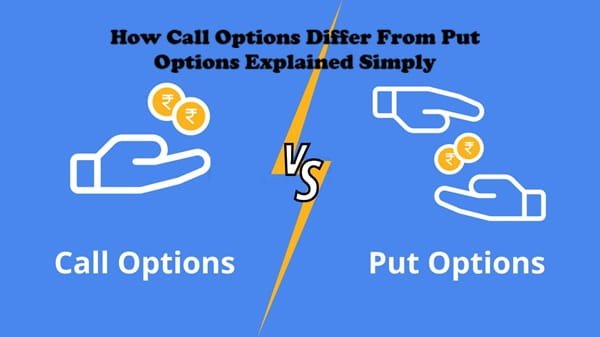
Call and put options can be used for speculation, hedging and portfolio management. However, their potential profits, risks and behaviour are different. Understanding these differences is essential before trading options.
What Is an Option?
An option is a derivative contract whose value is linked to an underlying asset. The underlying can be a stock, stock index, commodity, currency or another financial instrument.
Every option contract generally has several important components:
- Underlying asset: The asset or instrument on which the option is based.
- Strike price: The predetermined price at which the underlying can be bought or sold under the option.
- Premium: The price paid by the option buyer.
- Expiry date: The date on which the option contract expires.
- Option type: Call or put.
The key feature is that an option buyer has a right but generally not an obligation to exercise the option. The option seller, or writer, takes on the corresponding obligation if the buyer exercises the contract.
What Is a Call Option?
A call option gives the buyer the right to buy the underlying asset at the specified strike price on or before expiry, depending on the contract’s exercise style.
Investors generally buy calls when they expect the price of the underlying asset to increase.
For example, suppose a stock is trading at ₹100. An investor buys a call option with a strike price of ₹105 and pays a premium of ₹5.
If the stock rises substantially above ₹105, the call can become valuable because the investor has the right to buy at ₹105.
If the stock remains below the strike price at expiry, the option may expire worthless and the buyer’s loss is generally limited to the premium paid, subject to the contract’s terms and transaction costs.
What Is a Put Option?
A put option gives the buyer the right to sell the underlying asset at a specified strike price.
Investors generally buy puts when they expect the underlying asset’s price to fall.
For example, suppose a stock is trading at ₹100. An investor buys a put option with a strike price of ₹95 and pays a premium of ₹4.
If the stock falls substantially below ₹95, the put can become valuable because the investor has the right to sell at ₹95.
If the stock remains above ₹95 at expiry, the put may expire worthless and the buyer’s maximum loss is generally limited to the premium paid.
Call vs Put: The Simplest Difference
The easiest way to remember the difference is:
Call = Right to Buy
Put = Right to Sell
This also creates a broad directional relationship:
Call buyer → generally expects prices to rise
Put buyer → generally expects prices to fall
However, an investor does not necessarily need to own the underlying asset to buy an option. Options can be used in various trading and hedging strategies.
Call and Put Example
Consider a stock currently trading at ₹100.
Call Option
Suppose a trader buys a ₹105 call for a ₹5 premium.
If the stock rises to ₹120 at expiry, the option has ₹15 of intrinsic value. After considering the ₹5 premium, the simplified profit is ₹10 per share before transaction costs and taxes.
If the stock remains below ₹105, the call may expire worthless and the trader can lose the ₹5 premium.
Put Option
Now suppose another trader buys a ₹95 put for a ₹4 premium.
If the stock falls to ₹80, the put has ₹15 of intrinsic value. After the ₹4 premium, the simplified profit is ₹11 per share before applicable costs.
If the stock remains above ₹95 at expiry, the put may expire worthless and the trader can lose the ₹4 premium.
These examples are simplified and do not include brokerage, taxes, exchange charges or other applicable costs.
Maximum Loss and Profit Potential
For a call buyer, the maximum loss is generally the premium paid. The potential upside can be substantial because an asset’s price can theoretically continue rising.
For a put buyer, the maximum loss is also generally limited to the premium paid. The potential profit is substantial but constrained by the fact that an asset’s price cannot normally fall below zero.
This is different from option sellers.
Option writers receive the premium but take on obligations under the contract. Depending on the position, losses can be substantial. Therefore, buying options and selling options should not be treated as equivalent risk activities.
Breakeven Price
The breakeven level is another important difference.
For a basic call buyer:
Breakeven = Strike Price + Premium Paid
For a basic put buyer:
Breakeven = Strike Price − Premium Paid
For example, if a call has a ₹100 strike and a ₹5 premium, its simplified breakeven at expiry is ₹105.
If a put has a ₹100 strike and a ₹5 premium, its simplified breakeven at expiry is ₹95.
The underlying must move sufficiently in the expected direction to compensate for the premium paid.
Why Do Option Premiums Change?
The premium is not determined only by whether the underlying asset is rising or falling.
Several factors influence option prices, including:
- Current underlying price
- Strike price
- Time remaining until expiry
- Implied volatility
- Interest rates
- Expected dividends, where applicable
- Market demand and supply
This means an investor can correctly predict the direction of the underlying asset and still lose money on an option if the price movement is too small, occurs too slowly or is offset by changes in volatility and time value.
Call Options vs Put Options
| Feature | Call Option | Put Option |
| Buyer gets the right to | Buy | Sell |
| Typical market view | Bullish | Bearish |
| Maximum loss for buyer | Premium paid | Premium paid |
| Simplified breakeven | Strike + premium | Strike − premium |
| Benefits from | Rising underlying price | Falling underlying price |
| Common use | Upside speculation/hedging | Downside protection/speculation |
How Investors Use Call Options
Call options can be used for several purposes.
Bullish Trading
A trader expecting a substantial price increase may buy a call instead of purchasing the underlying asset directly.
Hedging Short Positions
A call can potentially protect a short position against an unexpected rise in the underlying asset.
Defined-Risk Strategies
For an option buyer, the premium generally defines the maximum loss, making the risk easier to quantify than some leveraged strategies.
However, limited maximum loss does not mean options are low-risk. The entire premium can be lost.
How Investors Use Put Options
Put options also have multiple applications.
Bearish Trading
A trader expecting a decline may buy a put.
Portfolio Protection
An investor holding shares may purchase puts to provide protection against a significant decline. This is sometimes called a protective put.
Managing Downside Risk
Puts can help establish a floor for the selling value of an underlying position, although the protection comes at the cost of the premium.
Calls and Puts Can Also Be Combined
Experienced traders can combine calls and puts to create strategies such as spreads, straddles and strangles.
These strategies can be designed for different expectations about direction, volatility or the size of a future price movement.
However, combining options also increases complexity. Traders need to understand how the positions interact, including their sensitivity to price, volatility and time.
Risks Investors Should Understand
Options involve several important risks:
- The option can expire worthless.
- The entire premium can be lost by the buyer.
- Time decay can reduce an option’s value.
- Volatility changes can affect premiums.
- Low liquidity can make execution difficult.
- Leverage can magnify gains and losses.
- Option selling can involve substantially greater risk than option buying.
SEBI has repeatedly cautioned investors that derivatives can involve significant leverage and that losses can be substantial. Investors should understand the contract and risk before trading.
Conclusion
The difference between call options and put options can be understood through one simple rule: a call gives the buyer the right to buy, while a put gives the buyer the right to sell.
Call buyers generally expect the underlying price to rise, while put buyers generally expect it to fall. For both buyers, the premium paid represents the primary maximum loss under a standard option purchase, although the option can expire worthless.
However, options are more than simple bets on whether prices will rise or fall. Their value is affected by strike price, expiry, volatility and other market factors. Option sellers also face a very different risk profile from option buyers.
For beginners, the most important step is to understand premium, strike price, expiry, breakeven and maximum potential loss before entering a trade. Once these fundamentals are clear, the difference between calls and puts becomes much easier to understand.
In simple terms, buy a call when you want exposure to a potential rise, buy a put when you want exposure to a potential fall, and remember that the option premium is a real cost that must be recovered before the trade becomes profitable.
 TBLTeam