 By Meghna Sharma
Natural gas and renewable energy represent two very different parts of the global energy market. Natural gas companies are linked to fossil-fuel production, transportation, processing, LNG and gas-based electricity generation, while renewable energy companies may operate in solar, wind, hydro, equipment manufacturing, power generation, storage and related infrastructure.
For investors, comparing natural gas vs renewable energy stocks is not simply a choice between an old energy source and a new one. The two segments have different revenue drivers, risks, capital requirements and growth opportunities. The better investment depends on an investor’s time horizon, risk tolerance and view of the energy transition.
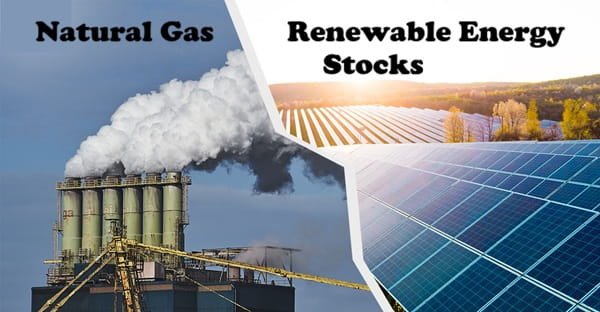
Globally, the energy system is changing rapidly. The International Energy Agency reported that renewables accounted for the majority of the increase in global electricity generation in 2025, while natural gas-fired generation still increased modestly. Natural gas remained an important source of electricity, accounting for about 21% of global generation.
What Are Natural Gas Stocks?
Natural gas stocks represent companies whose businesses are connected to the natural gas value chain.
They may be involved in:
- Natural gas exploration and production
- Gas processing
- LNG
- Pipelines and transportation
- City gas distribution
- Gas-based power generation
- Gas trading and marketing
Their financial performance can be influenced by gas prices, production volumes, demand, infrastructure utilisation, government policies and global energy markets.
Natural gas also plays an important role in electricity systems because gas-fired plants can provide flexibility when electricity demand changes or renewable generation is unavailable. The IEA expects natural gas-fired generation to continue growing in 2026, although at a moderate pace.
What Are Renewable Energy Stocks?
Renewable energy stocks represent companies involved in energy sources that are naturally replenished, particularly:
- Solar power
- Wind power
- Hydropower
- Renewable power generation
- Solar and wind equipment
- Batteries and energy storage
- Renewable-energy infrastructure
India has been rapidly expanding its renewable capacity. According to the Ministry of New and Renewable Energy, cumulative renewable-energy capacity, including large hydro, reached about 295.55 GW as of August 31, 2026, with solar capacity at approximately 168.04 GW and wind capacity at about 58.52 GW.
This expansion creates potential opportunities for companies involved in renewable generation, manufacturing and supporting infrastructure.
Natural Gas vs Renewable Energy: Growth Potential
Renewable energy generally has a stronger long-term growth narrative because countries are increasing investment in low-emission electricity and electrification.
The IEA’s 2025 energy-investment outlook estimated that global energy investment would reach approximately $3.3 trillion, with about $2.2 trillion directed toward clean-energy areas such as renewables, grids, storage, nuclear, efficiency and electrification—roughly twice the amount going toward oil, natural gas and coal.
However, this does not mean natural gas has no growth opportunity.
Natural gas can remain important for:
- Meeting peak electricity demand
- Balancing variable renewable generation
- Industrial applications
- LNG supply
- Energy security
- Replacing more carbon-intensive fuels in some markets
Therefore, renewable energy may offer stronger structural growth, while natural gas can continue benefiting from near- and medium-term energy demand and system-flexibility requirements.
Revenue and Profit Drivers
The two industries have very different business models.
Natural gas companies can be strongly affected by commodity prices. When gas prices rise, producers may benefit from higher revenues, while high prices can hurt demand for gas-fired generation or industrial consumption.
Renewable energy companies are generally more dependent on:
- Electricity prices
- Power-purchase agreements
- Project costs
- Interest rates
- Equipment prices
- Government incentives and regulations
- Capacity additions
A renewable power producer with long-term contracts may have relatively predictable revenue compared with a gas producer exposed to volatile commodity prices.
However, renewable companies can require substantial upfront capital for projects, making financing conditions particularly important.
Dividend Potential
Natural gas companies, particularly mature infrastructure and utility-related businesses, may provide comparatively attractive dividend opportunities.
Pipeline, distribution and established energy businesses can generate recurring cash flows when their assets are well utilised.
Renewable energy companies may instead reinvest significant cash into new projects, manufacturing capacity, technology and expansion. Consequently, some renewable companies may prioritise growth over dividends.
However, dividend policy varies considerably between individual companies, so investors should examine cash flow, debt and payout sustainability rather than judging an entire sector by its average dividend yield.
Risk Comparison
Both categories can be volatile, but the sources of risk are different.
Natural Gas Stock Risks
Natural gas companies can face:
- Commodity-price volatility
- Geopolitical risks
- Regulatory changes
- Environmental regulations
- Demand fluctuations
- Pipeline or infrastructure constraints
- High capital expenditure
- Transition-related risks
For example, higher gas prices can increase producer earnings but may simultaneously reduce demand from price-sensitive customers.
Renewable Energy Stock Risks
Renewable energy companies can face:
- High capital requirements
- Interest-rate sensitivity
- Policy changes
- Land and permitting issues
- Supply-chain disruptions
- Technology changes
- Competition
- Project execution delays
- Power-price risks
Renewable-energy stocks can also experience significant valuation volatility when investors price in high future growth expectations.
Natural Gas vs Renewable Energy Stocks: Comparison
| Factor | Natural Gas Stocks | Renewable Energy Stocks |
| Main exposure | Gas, LNG, infrastructure, power | Solar, wind, hydro, storage |
| Commodity sensitivity | Generally high for producers | Usually lower |
| Long-term growth driver | Energy demand and flexibility | Energy transition and electrification |
| Policy dependence | Moderate to high | Often high |
| Capital requirements | Can be high | Often high |
| Dividend potential | Often stronger in mature businesses | Varies; growth companies may reinvest |
| Major risk | Gas prices and transition policies | Financing, execution and valuation |
| Growth profile | More mature in many markets | Higher structural growth potential |
| Environmental transition risk | Higher | Generally lower |
| Technology risk | Moderate | Potentially significant |
Which Is More Volatile?
There is no universal answer because volatility depends heavily on the individual company.
A natural gas producer can experience significant share-price movements when commodity prices change. A renewable-energy developer may be highly sensitive to interest rates because its projects require substantial financing.
Renewable stocks can also experience sharp valuation changes when market expectations about future growth change.
Therefore, investors should examine beta, standard deviation, debt levels, cash flows and valuation instead of assuming that one energy segment is always more volatile than the other.
The Importance of Government Policy
Energy businesses are closely connected to government policy.
Natural gas companies can be affected by environmental regulations, domestic gas policies, pricing rules, LNG policies and infrastructure decisions.
Renewable companies can benefit from policies supporting clean-energy capacity, manufacturing, grid development and electrification. At the same time, changes in subsidies, taxation, import rules or project regulations can affect expected returns.
This policy exposure means investors should understand the regulatory environment before investing in energy stocks.
Should Investors Choose One Over the Other?
The choice depends on the investment thesis.
An investor who expects continued gas demand, LNG growth and the need for flexible power generation may find natural gas companies attractive.
An investor focused on long-term electrification, solar and wind expansion, energy storage and the global transition toward lower-emission energy may prefer renewable-energy companies.
Investors do not necessarily have to treat the two sectors as mutually exclusive. A diversified energy portfolio could potentially include companies benefiting from conventional energy demand as well as businesses participating in the energy transition.
However, concentrated exposure to a single energy theme can increase risk. SEBI notes that sectoral and thematic investments can involve higher concentration and volatility because they are restricted to particular sectors or themes.
What Should Investors Check Before Buying?
Before investing in either category, examine:
- Revenue growth: Is the company’s business actually expanding?
- Profit margins: Can the company convert revenue into sustainable profits?
- Debt: High borrowing can become particularly problematic when interest rates rise.
- Cash flow: Accounting profits should be supported by operating cash generation.
- Valuation: Strong growth expectations may already be reflected in the share price.
- Government policies: Energy businesses can be highly policy-sensitive.
- Competitive position: Examine technology, assets, costs and market share.
- Management quality: Capital allocation is particularly important in capital-intensive industries.
Conclusion
Natural gas vs renewable energy stocks represents a comparison between two different energy-investment themes rather than a simple winner-and-loser choice.
Natural gas can continue to benefit from energy demand, LNG, industrial consumption and the need for flexible electricity generation. Renewable energy, meanwhile, has powerful long-term growth drivers from solar and wind expansion, electrification, decarbonisation and increasing clean-energy investment.
Renewable energy may offer stronger structural growth potential, but its stocks can carry significant valuation, financing and execution risks. Natural gas stocks may provide stronger exposure to current energy markets and, in some cases, established cash flows and dividends, but they face commodity volatility and longer-term transition risks.
For investors, the better approach is to evaluate individual companies rather than choosing an entire sector based only on its growth story. Financial strength, valuation, debt, cash flow, competitive advantages and policy exposure can matter just as much as the broader energy trend.
In simple terms, natural gas stocks may appeal to investors seeking exposure to conventional energy demand and energy-system flexibility, while renewable energy stocks may suit investors seeking long-term exposure to the expanding clean-energy economy.