 By Meghna Sharma
Yes, a minor can have a Demat account in India, but it operates under different rules from a regular adult Demat account. The account is opened in the minor’s name and is operated by a guardian until the minor reaches the age of majority. SEBI specifically permits Demat accounts to be opened for minors, subject to applicable KYC and account-opening requirements.
However, having a minor Demat account does not mean that the child can freely trade stocks like an adult. The rules are particularly important when it comes to buying and selling securities, because a minor cannot independently enter into a normal contract with a stockbroker.
What Is a Minor Demat Account?
A Demat account is an electronic account used to hold securities such as shares, bonds, ETFs and other eligible investments.
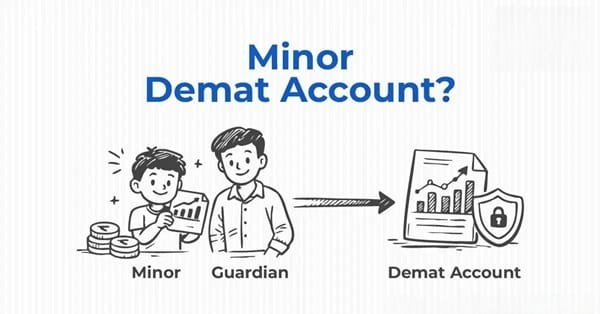
For a minor, the account is opened in the minor’s own name, but it is operated by a guardian until the minor becomes a major.
According to SEBI’s FAQ, the guardian is generally the father, or in his absence, the mother. If neither is available, a court-appointed guardian may operate the account.
The minor is the account holder, while the guardian manages the account on the minor’s behalf.
This structure allows parents or legal guardians to build investments for a child while keeping the securities legally associated with the minor’s account.
Can a Minor Be a Joint Holder?
No.
SEBI’s rules specify that a minor cannot be a joint holder in a Demat account. A minor’s Demat account must therefore be structured appropriately with the minor as the account holder rather than being added as one of several joint holders.
This is an important distinction for parents who already have their own Demat account and are considering adding their child to it.
Instead of making the child a joint holder, parents generally need to open a separate Demat account in the minor’s name, operated by the eligible guardian.
Who Operates the Minor’s Demat Account?
The guardian operates the account until the minor reaches majority.
The guardian is responsible for completing the required account-opening and KYC formalities and for managing the securities according to the applicable rules.
The minor’s account therefore does not function like an ordinary adult trading account where the account holder independently places orders.
The guardian’s role is central to the account’s operation.
Can a Minor Buy and Sell Shares?
This is where the rules become particularly important.
A minor cannot independently enter into a contract with a stockbroker to purchase or sell securities.
SEBI permits a trading account to be opened in the minor’s name only for the limited purpose of selling securities that the minor has already acquired through specified routes. These include securities received through an IPO, inheritance, corporate action, gifts or donations, transfers between family members, and certain transfers made under government or regulatory directions or orders.
Therefore, parents should not assume that opening a minor Demat account gives the child unrestricted stock-trading privileges.
For example, if a child receives shares as a gift from a family member, the shares can be held in the minor’s Demat account. The applicable rules allow a minor’s trading account to facilitate permitted sales of such securities.
But a minor cannot simply operate a normal trading account and continuously buy and sell stocks like an adult investor.
Can Parents Invest in Shares for Their Child?
A minor Demat account can be useful when securities are being accumulated for the child’s benefit.
For example, eligible securities may come into the minor’s account through:
- Gifts
- Donations
- Inheritance
- IPO allotments
- Corporate actions
- Permitted family transfers
The important point is that the investment belongs to the minor, while the guardian manages the account until the minor reaches majority.
Parents should therefore maintain clear records showing the source and ownership of the securities.
What Documents Are Required?
The exact documentation can vary depending on the Depository Participant, but a minor Demat account requires appropriate KYC documentation for both the minor and guardian.
SEBI states that both the guardian and minor must comply with applicable KYC requirements when opening a minor Demat or trading account.
Depending on the intermediary, documentation can include details relating to:
- Minor’s identity
- Minor’s date of birth
- PAN, where applicable
- Guardian’s identity
- Guardian’s PAN
- Address details
- Proof of relationship
- Bank-account information
- Guardianship documents where required
CDSL’s guidance also confirms that guardian details must be provided for minor accounts and that the minor should be the sole holder.
Parents should check the current requirements of their chosen Depository Participant before submitting an application.
What Happens When the Minor Turns 18?
A minor’s Demat account does not simply continue operating under the guardian’s control forever.
When the minor becomes a major, the account status needs to be updated.
SEBI states that the Demat/trading account can continue after the minor becomes a major, but the individual must confirm the balance and complete the formalities required for continuing the account in their own capacity.
CDSL also describes two possible approaches: the existing account may be closed and a new account opened in the individual’s name, with securities transferred to the new account, or the existing account may continue after the necessary formalities are completed and guardian details are removed.
Therefore, parents should not wait until long after the child’s 18th birthday to update the account.
What Happens to the Guardian’s Authority?
Once the minor becomes a major, the individual becomes responsible for operating the account.
The guardian’s authority under the minor-account arrangement ends, subject to completion of the required transition formalities.
The newly major investor may need to provide updated information and execute the documents required by the Depository Participant.
The DP will then update the account according to the applicable process.
Can a Minor Participate in an IPO?
A minor can have securities credited to a Demat account through an IPO, subject to the applicable issue and application requirements.
SEBI specifically identifies securities acquired through investment in an IPO among the securities that can be sold through a trading account maintained in the minor’s name.
However, parents should check the current IPO application rules, platform requirements and eligibility conditions before applying.
The existence of a minor Demat account alone does not guarantee that every IPO application route will be available to the minor.
Minor Demat Account vs Adult Demat Account
| Feature | Minor Demat Account | Adult Demat Account |
| Account holder | Minor | Adult |
| Can be opened in own name | Yes | Yes |
| Operated by | Guardian until majority | Account holder |
| Joint holding with minor | Not permitted | Permitted subject to rules |
| Normal independent trading | Not permitted | Generally permitted |
| Holding investments | Yes | Yes |
| KYC required | Minor + guardian | Account holder |
| After age 18 | Status must be updated | No minor-to-major conversion |
The key difference is therefore not the ability to hold securities, but who has legal authority to operate the account and what transactions are permitted.
Why Open a Demat Account for a Minor?
Parents may consider a minor Demat account for legitimate long-term financial planning.
Potential reasons include:
- Holding inherited shares
- Receiving eligible gifts
- Holding IPO-allotted securities
- Receiving securities through corporate actions
- Building an investment portfolio for the child
It can also help establish financial ownership in the child’s name from an early age.
However, parents should understand the applicable tax rules separately because income or gains associated with a minor’s investments can have tax consequences depending on the circumstances.
Important Precautions for Parents
Parents should treat the account as the child’s investment account rather than as an additional personal trading account.
They should:
- Keep the minor’s and guardian’s documents updated.
- Maintain accurate records of how securities were acquired.
- Avoid unauthorised trading activity.
- Monitor corporate actions and account statements.
- Keep login and account credentials secure.
- Update the account promptly when the child reaches 18.
- Check current rules with the Depository Participant before transferring securities.
Parents should also avoid using the minor’s account merely to bypass normal trading or investment rules.
Conclusion
A minor can open a Demat account in India, but the account is subject to specific rules and is operated by a guardian until the minor becomes a major. SEBI expressly permits Demat accounts in a minor’s name, while requiring the applicable KYC compliance of both the minor and guardian.
The minor cannot simply use the account as an ordinary adult trading account. A trading account in the minor’s name is restricted primarily to selling securities that the minor has acquired through permitted routes such as IPOs, inheritance, gifts, donations, corporate actions and certain family transfers.
The minor also cannot be a joint holder in another Demat account.
When the minor reaches 18, the account must undergo the required transition process. The individual then takes control as an adult account holder after completing the necessary formalities.
For parents, the main benefit of a minor Demat account is that eligible securities can be held in the child’s name under guardian management. However, it is important to follow KYC, custody, transaction and tax requirements carefully.
Ultimately, a minor Demat account is designed primarily for holding and managing investments on behalf of a child—not for unrestricted stock trading by the child. Understanding this distinction can help parents use the account appropriately while avoiding regulatory and administrative problems.