 By Meghna Sharma
Investors often focus on a mutual fund’s past returns when deciding where to invest. However, returns alone do not explain how much risk a scheme may involve. To make risk easier to understand, the Securities and Exchange Board of India (SEBI) requires mutual fund schemes to display a Riskometer.
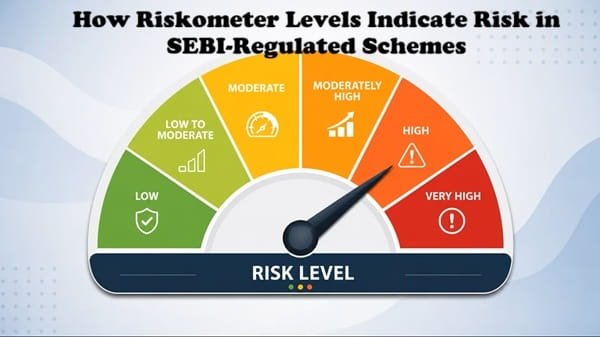
The Riskometer is a visual risk-labeling tool that indicates the level of risk associated with a mutual fund scheme. It uses six categories, ranging from Low Risk to Very High Risk. The classification is based on the characteristics and portfolio of the scheme and is reviewed periodically. SEBI’s current framework requires the Riskometer to be evaluated monthly and disclosed with portfolio information.
What Is a Mutual Fund Riskometer?
A Riskometer is designed to give investors a quick indication of the level of risk associated with a mutual fund scheme.
Instead of requiring investors to interpret several technical risk measures, the Riskometer presents risk through six standardized categories:
- Low Risk
- Low to Moderate Risk
- Moderate Risk
- Moderately High Risk
- High Risk
- Very High Risk
These categories provide a common framework for comparing the broad risk level of different mutual fund schemes. SEBI requires mutual funds to display the Riskometer as part of their scheme disclosures.
However, the Riskometer should be viewed as a risk indicator, not a prediction of returns or losses. A higher Riskometer level does not guarantee higher returns, and a lower level does not mean that an investment is completely safe.
The Six Riskometer Levels Explained
1. Low Risk
The Low Risk category represents schemes with relatively limited risk according to the prescribed assessment methodology.
Such schemes may generally have exposure to assets with lower levels of market, credit or interest-rate risk compared with higher-risk investments.
However, “Low Risk” does not mean risk-free. Mutual fund investments remain subject to investment risks, and investors should examine the scheme’s underlying portfolio and objective.
2. Low to Moderate Risk
The Low to Moderate Risk level indicates a higher degree of risk than the Low category but comparatively lower risk than moderate and higher classifications.
Investors may encounter some fluctuations in the value of their investment. The actual level of risk depends on the assets held by the particular scheme.
This category can therefore be viewed as an intermediate level between relatively low-risk investments and schemes with more substantial market exposure.
3. Moderate Risk
A Moderate Risk rating indicates a meaningful level of investment risk.
The NAV of such schemes may experience noticeable fluctuations depending on market conditions and the securities held in the portfolio.
Investors should examine the investment horizon and financial objective before investing rather than selecting a scheme solely because its Riskometer appears manageable.
4. Moderately High Risk
The Moderately High Risk category indicates that investors may face significant fluctuations in the value of their investment.
Schemes with substantial exposure to market-sensitive securities may fall into higher Riskometer categories depending on their portfolio characteristics and the prescribed methodology.
Investors considering such schemes should generally have an appropriate time horizon and ability to tolerate market volatility.
5. High Risk
A High Risk rating indicates a substantial level of investment risk.
The value of investments can experience significant fluctuations, particularly when the underlying securities are affected by adverse market conditions.
Investors should not interpret the High Risk label as an indication that a scheme will necessarily produce high returns. It primarily communicates the level of risk associated with the scheme.
6. Very High Risk
Very High Risk is the highest Riskometer category.
It indicates that the scheme has characteristics associated with a very high level of investment risk under SEBI’s prescribed framework.
Equity-oriented and other market-sensitive schemes can fall into this category, although the actual classification depends on the scheme’s portfolio and methodology.
A Very High Risk label means investors should have a strong capacity to tolerate fluctuations and should consider whether the scheme is appropriate for their investment objective and time horizon.
How Is the Riskometer Level Determined?
The Riskometer is not simply assigned according to whether a fund is called an equity, debt or hybrid fund.
The assessment considers the characteristics of the scheme and its underlying portfolio. Depending on the type of scheme, factors can include market risk, credit risk, interest-rate sensitivity and other relevant portfolio characteristics.
SEBI’s current mutual-fund framework provides detailed methodologies and examples for calculating the Riskometer value. For example, the framework includes calculations based on portfolio-level parameters for equity schemes.
This means the Riskometer can change when the risk characteristics of a scheme’s portfolio change.
Why Can a Scheme’s Riskometer Change?
A mutual fund’s portfolio is not necessarily static.
For example, a scheme may change its exposure to different securities, sectors, issuers, asset classes or maturity profiles. These changes can affect its assessed risk.
Consequently, a scheme that was previously classified at one risk level may subsequently receive another classification.
SEBI’s framework requires changes in the Riskometer to be communicated to investors through prescribed disclosures, including notice/addendum and electronic communication to affected unitholders.
How Frequently Is the Riskometer Reviewed?
The Riskometer is evaluated on a monthly basis.
Mutual funds are required to disclose the Riskometer along with portfolio disclosure on their websites and on the AMFI website within 10 days from the close of each month. The annual disclosure also includes the scheme’s risk level as of March 31 and the number of times its risk level changed during the year.
This periodic review is important because a fund’s risk profile can change over time.
Riskometer for the Scheme vs Benchmark
Investors may also encounter a benchmark Riskometer.
SEBI requires the scheme’s Riskometer and benchmark Riskometer to be disclosed in specified performance comparisons. This allows investors to see not only the risk classification of the mutual fund but also the risk level associated with its benchmark.
For example, if a scheme has a substantially different risk classification from its benchmark, an investor may want to investigate why. The difference could reflect the portfolio’s construction, asset allocation or other characteristics.
Does a Higher Riskometer Mean Higher Returns?
No.
The Riskometer indicates risk, not expected return.
A Very High Risk scheme does not automatically have better long-term performance than a Moderate Risk scheme. Similarly, a Low Risk scheme is not guaranteed to protect investors from every loss.
Risk and return are related concepts, but the relationship is not a guarantee. Actual returns depend on market conditions, portfolio decisions, valuations, costs and many other factors.
Investors should therefore avoid choosing a fund solely because its Riskometer is high or low.
How Investors Should Use the Riskometer
The Riskometer works best as a starting point for risk assessment.
Before investing, investors can use it to:
- Identify the broad risk level of a scheme.
- Compare schemes within the same category.
- Check whether the fund’s risk level matches their tolerance.
- Monitor whether the scheme’s risk classification changes.
- Examine the underlying portfolio for a deeper assessment.
For example, an investor with a short-term financial goal may be uncomfortable with a scheme carrying a Very High Risk label because substantial market fluctuations could occur before the money is needed.
An investor with a long-term horizon and higher risk tolerance may be more comfortable considering a higher-risk equity scheme.
Riskometer Is Not a Substitute for Detailed Research
Although the Riskometer makes risk easier to understand, it does not capture every aspect of an investment decision.
Investors should also examine:
- Investment objective
- Asset allocation
- Portfolio concentration
- Credit quality, where relevant
- Interest-rate sensitivity for debt funds
- Historical volatility
- Maximum drawdown
- Expense ratio
- Benchmark performance
- Fund manager and investment strategy
- Investment horizon
For example, two schemes can have the same Riskometer level but have very different portfolios and investment strategies.
Riskometer vs Risk-Adjusted Performance Ratios
The Riskometer should also be distinguished from measures such as Sharpe Ratio, Sortino Ratio, Alpha and Beta.
The Riskometer communicates the scheme’s regulatory risk classification, while these ratios provide additional information about historical risk and performance.
For example, the Sharpe Ratio evaluates historical excess return relative to total volatility, whereas Beta measures sensitivity to a benchmark. These metrics answer different questions from the Riskometer.
Therefore, an investor should not replace one with another. They can be used together for a more complete analysis.
Conclusion
The Riskometer is an important SEBI-mandated tool for understanding the broad level of risk associated with mutual fund schemes. Its six categories range from Low Risk to Very High Risk, providing investors with a standardized and easy-to-understand risk indicator.
Because mutual fund portfolios can change, the Riskometer is evaluated monthly, and changes in the risk level are disclosed to investors.
However, the Riskometer should not be treated as a guarantee of safety or returns. A better investment decision comes from combining the Riskometer with the scheme’s objective, portfolio, investment horizon, costs and other risk and performance measures.
In simple terms, the Riskometer tells investors how risky a SEBI-regulated mutual fund scheme is considered under the prescribed framework, while detailed fund analysis helps explain why that risk exists and whether it fits the investor’s financial goals.