 By Meghna Sharma
BTST, or Buy Today, Sell Tomorrow, is a trading strategy in which an investor buys shares on one trading day and sells them on the following trading day, before the original purchase has been fully settled into the investor’s demat account.
BTST became particularly relevant after India’s equity market moved to a T+1 settlement cycle, under which eligible equity trades are normally settled on the next working day. NSE Clearing states that securities and funds pay-in and pay-out for normal T+1 trades take place on T+1, while short deliveries can move into an auction process.
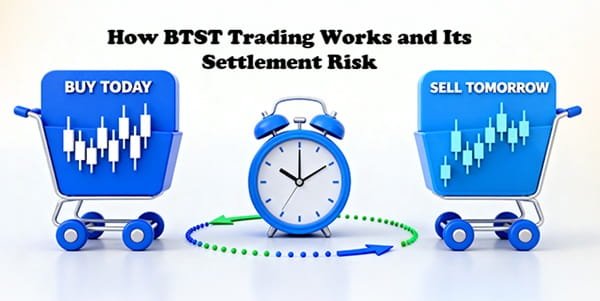
Although BTST can allow traders to take advantage of short-term price movements, it also involves an important settlement risk. The investor may sell shares before the shares purchased on the previous day have actually been delivered to the demat account.
What Does BTST Mean?
BTST stands for Buy Today, Sell Tomorrow.
Under a conventional delivery trade, an investor buys shares on Monday and expects those shares to be credited to the demat account on the next settlement day. In a BTST transaction, however, the investor sells those shares on Tuesday rather than waiting for the Monday purchase to settle.
For example:
- Monday: Buy 100 shares.
- Tuesday: Sell the 100 shares.
- Wednesday: The original Monday purchase would normally settle under the T+1 cycle, subject to the applicable settlement calendar.
An NSE document describing BTST explains that the strategy involves buying shares on T day and selling them on T+1 before the purchase trade has been settled and the shares delivered to the investor’s demat account.
The strategy therefore depends on the broker and clearing system being able to manage the corresponding settlement obligations.
How Does BTST Work?
Suppose an investor buys 100 shares of Company A at ₹500 on Monday.
The total purchase value is:
100 × ₹500 = ₹50,000
On Tuesday, the share price rises to ₹520. The investor sells the 100 shares.
The simplified trading profit is:
100 × (₹520 − ₹500) = ₹2,000
The investor has effectively captured a one-day price movement without waiting for the purchased shares to arrive in the demat account.
The actual net profit will be lower after applicable brokerage, taxes, exchange charges and other costs.
The important point is that the investor has sold before the original purchase has completed its normal settlement process.
Why Is BTST Possible?
India’s securities market operates through a clearing and settlement mechanism designed to match buyers’ and sellers’ obligations.
NSE Clearing’s current equity settlement framework follows T+1 and T+0 rolling settlement cycles. Under T+1, the final obligations are generated on T+1 and securities and funds are settled on that working day.
This system allows brokers to support eligible BTST transactions according to their own risk-management and operational processes.
However, BTST should not be interpreted as meaning that the investor already owns the shares in the demat account immediately after placing the purchase order.
What Is Settlement Risk in BTST?
The main risk arises when the shares purchased on T day are not delivered into the settlement system as expected.
For example, imagine:
- Investor A buys 100 shares on Monday.
- Investor B sells those shares on Monday.
- Investor B is supposed to deliver the shares through the settlement process.
- Investor A plans to sell the shares on Tuesday through BTST.
If Investor B fails to deliver the securities, there can be a short delivery.
This matters because Investor A’s Tuesday sale creates a delivery obligation, while the shares originally purchased may not have been received in time.
The clearing corporation therefore has procedures for handling shortages.
What Happens in a Short Delivery?
NSE Clearing states that when securities are not delivered on the settlement day in the normal segment, it conducts a buy-in auction on T+1 after completion of pay-out. The auction is intended to obtain the securities that were not delivered.
This is an important protection within the settlement system, but it does not mean that BTST carries no risk for the trader.
The outcome can depend on whether the required securities are successfully obtained through the auction and on the applicable close-out mechanism.
Auction Risk for BTST Traders
Suppose an investor buys 100 shares at ₹500 and sells them through BTST at ₹520.
The investor expects the shares to be available to meet the Tuesday sale obligation.
However, if the original seller fails to deliver the shares, the clearing corporation may need to procure the securities through the auction process.
If the auction price is higher than the applicable valuation price, the clearing member is required to make good the difference under the exchange’s shortage-handling framework.
Depending on the broker’s policies and the circumstances, these costs or related obligations can ultimately affect the client who created the short delivery.
Therefore, a BTST trade that appeared profitable can potentially face additional settlement-related costs.
What If the Auction Cannot Obtain the Shares?
An auction does not necessarily guarantee that the required securities will always be available.
NSE’s shortage-handling framework states that shortages not bought in are deemed closed out. In certain cases, close-out is calculated using prescribed pricing rules, including the highest price prevailing across exchanges from the original trade date through the auction day or a specified premium over the auction-day settlement price, as applicable.
This can create an unexpected financial impact.
For this reason, traders should understand that the price at which they sold their BTST shares is not necessarily the only price relevant to the final settlement outcome.
BTST vs Normal Delivery Trading
| Feature | Normal Delivery | BTST |
| Purchase | Buy shares | Buy shares |
| Sale timing | Usually after receiving/settling holdings | Sell on next trading day |
| Settlement exposure | Lower after shares are credited | Higher before purchase settlement |
| Main objective | Investment or longer holding | Short-term opportunity |
| Short-delivery concern | Generally lower after receipt | More relevant |
| Price risk | Market-dependent | High due to short holding period |
| Suitable for | Investors | Experienced short-term traders |
BTST is therefore not simply a faster version of normal investing. It involves a different settlement profile.
BTST Is Different From Intraday Trading
BTST should also be distinguished from intraday trading.
In intraday trading, a trader buys and sells the position during the same trading session and generally does not intend to carry a delivery position overnight.
In BTST, the trader buys on one day and sells on the following trading day.
For example:
Intraday: Buy Monday → Sell Monday
BTST: Buy Monday → Sell Tuesday
Delivery: Buy Monday → Hold beyond settlement and potentially sell later
The settlement and margin treatment can differ depending on the product and broker.
What Are the Other Risks of BTST?
Settlement risk is only one part of BTST trading.
1. Price Risk
The share price may fall sharply between the purchase and the next day’s sale.
2. Gap Risk
A stock can open substantially higher or lower after overnight news, leaving the trader with limited control over the opening price.
3. Liquidity Risk
Less-liquid stocks may have wider spreads or insufficient buyers at the desired price.
4. Corporate Action Risk
Corporate actions around record dates can create additional settlement complications, and NSE has specific procedures for shortages involving securities affected by corporate actions.
5. Broker Risk Controls
Brokers may impose their own restrictions, margins or eligibility requirements on BTST transactions.
6. Concentration Risk
Putting a large portion of capital into one short-term position can magnify portfolio losses.
How Can Traders Reduce BTST Settlement Risk?
Traders can take several practical precautions:
- Understand the broker’s BTST policy before placing the trade.
- Avoid assuming that buying shares means they are already settled.
- Be particularly careful with illiquid securities.
- Check corporate actions and settlement holidays.
- Maintain adequate funds for unexpected obligations.
- Avoid excessive position sizes.
- Understand auction and close-out rules.
- Keep records of trade and settlement dates.
NSE notes that intervening holidays, including relevant bank holidays, exchange holidays, Saturdays and Sundays, are excluded when determining settlement dates.
Therefore, traders should not assume that “tomorrow” always means the next calendar day for settlement purposes.
Is BTST Suitable for Beginners?
BTST may appear simple because the basic strategy is just buying today and selling tomorrow. The settlement mechanics, however, can be more complicated.
Beginners should first understand:
- T+1 settlement
- Delivery obligations
- Short delivery
- Auction procedures
- Close-out rules
- Brokerage and taxes
- Gap risk
- Position sizing
A trader should also understand that a profitable price movement does not automatically eliminate settlement-related risks.
Conclusion
BTST trading allows investors to buy shares on one trading day and sell them on the next trading day, before the original purchase has completed its normal settlement process. India’s T+1 settlement system makes this strategy operationally possible through the clearing and settlement framework, but it also creates a specific settlement risk.
The most important risk occurs when the securities originally purchased are not delivered as expected. In such situations, the clearing corporation can use an auction or applicable close-out mechanism to address the shortage.
BTST can be useful for traders seeking short-term opportunities, but it should not be confused with risk-free delivery trading. Price gaps, liquidity problems, corporate actions and settlement shortages can all affect the final outcome.
In simple terms, BTST lets you sell tomorrow what you bought today, but the shares may not yet have completed their settlement journey. Understanding that settlement gap is essential before using BTST as a trading strategy.
 TBLTeam