 By Meghna Sharma
Stock-market investors can participate in equity markets through different trading approaches. Two of the most common are intraday trading and delivery-based stock trading. Although both involve buying and selling shares, the way positions are held, the risks involved, the use of leverage and the settlement process can be very different.
In simple terms, intraday trading means buying and selling a position within the same trading day, while delivery-based trading involves taking ownership of shares and holding them beyond the trading session. India’s equity market generally follows a T+1 rolling settlement cycle for normal trades, although an optional T+0 settlement segment also exists for eligible securities and participants.
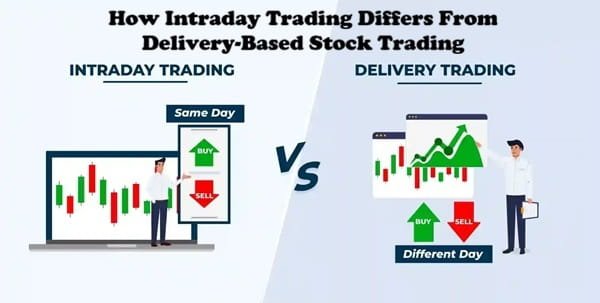
Understanding these differences is important before deciding which approach fits an investor’s financial objectives and risk tolerance.
What Is Intraday Trading?
Intraday trading involves opening and closing a stock position during the same trading session.
For example, a trader buys 100 shares of a company at ₹500 in the morning and sells them at ₹510 before the trading session ends.
The gross profit would be:
100 × (₹510 − ₹500) = ₹1,000
The trader does not intend to carry the position overnight.
If the share price instead falls to ₹490 and the trader sells at that price, the gross loss would be ₹1,000, before applicable charges.
Intraday traders generally focus on short-term price movements rather than the long-term value of the company.
What Is Delivery-Based Stock Trading?
In delivery-based trading, an investor purchases shares with the intention of holding them beyond the trading day. The securities are settled through the normal equity settlement process and, once delivered, become part of the investor’s demat holdings.
For a normal T+1 trade, NSE Clearing determines the obligations on the trade date and securities and funds are settled on the following working day, subject to the applicable settlement calendar.
For example, an investor may purchase 50 shares at ₹500 and hold them for several months or years. The investor can potentially benefit from capital appreciation, dividends and other corporate actions during the holding period.
Intraday vs Delivery: The Main Difference
The biggest difference is how long the position is held.
| Feature | Intraday Trading | Delivery-Based Trading |
| Holding period | Same trading day | Beyond the trading day |
| Main objective | Short-term price movements | Investment or longer-term growth |
| Overnight position | Generally closed | Can be held |
| Demat ownership | Usually not taken as a delivery position | Shares are delivered to demat |
| Leverage | May be available depending on broker/product | Generally lower |
| Market exposure | Short-term | Potentially long-term |
| Main risk | Short-term volatility and leverage | Market and business risk over holding period |
The distinction is therefore not simply about buying or selling shares. It is about the nature and duration of the exposure.
How Settlement Works
Settlement is an important part of delivery trading.
Under the normal T+1 rolling settlement system, a trade executed on day T is normally settled on the next working day. NSE states that securities and funds pay-in and pay-out for normal T+1 trades take place on T+1.
For example:
Monday: Buy shares
Tuesday: Settlement and delivery, subject to the applicable settlement process
If Tuesday is a market or bank holiday, the settlement date can move according to the applicable settlement calendar. NSE specifically excludes intervening holidays, Saturdays and Sundays when determining settlement dates.
Intraday trades, by contrast, are generally squared off within the trading session and are not intended to result in delivery of shares to the investor’s demat account.
Leverage in Intraday Trading
One reason intraday trading attracts traders is the possibility of using leverage or margin, depending on the broker and applicable regulatory requirements.
Leverage allows a trader to take a position whose value can be larger than the cash immediately available.
For example, a trader with ₹20,000 may be able to take a larger intraday position under the broker’s applicable margin framework.
However, leverage magnifies losses as well as profits.
A 2% adverse movement on a leveraged position can have a much larger effect on the trader’s actual capital than a 2% movement on an unleveraged investment.
Therefore, intraday trading can expose investors to substantial short-term financial risk.
Delivery Trading and Long-Term Ownership
Delivery-based trading is generally more closely associated with investing.
Once shares are delivered into the investor’s demat account, they can potentially be held for an extended period.
Long-term investors may focus on:
- Company earnings
- Revenue growth
- Profitability
- Competitive advantages
- Debt levels
- Management quality
- Valuation
- Industry trends
- Dividends
The investor does not need to predict the stock’s movement every day.
This can make delivery investing more suitable for people who want to participate in the long-term growth of businesses rather than repeatedly trade short-term price movements.
Risk Difference
Both approaches involve risk, but the type of risk can differ.
Intraday Risk
Intraday traders face:
- Rapid price fluctuations
- Leverage risk
- Market volatility
- Execution risk
- Slippage
- Emotional decision-making
- Sudden news events
A stock can move sharply within minutes, making risk management essential.
Delivery Risk
Delivery investors may face:
- Long-term market declines
- Company-specific problems
- Sector downturns
- Economic recessions
- Corporate governance issues
- Valuation risk
However, delivery investors are not required to close their positions simply because the stock falls during one trading session. They can continue holding if the investment thesis remains valid.
Overnight and Gap Risk
One important difference is overnight exposure.
Intraday traders generally close their positions before the end of the trading session, reducing their exposure to overnight news.
Delivery investors remain exposed to events occurring after the market closes.
For example, a company could announce disappointing earnings after market hours. Its stock might then open significantly lower the next morning.
This is called gap risk.
While avoiding overnight exposure can reduce one type of risk, intraday traders still face significant risks during market hours.
Costs Can Also Differ
Frequent trading can result in higher cumulative transaction costs.
Intraday traders may execute numerous trades within a short period. Depending on the broker and transaction type, costs can include brokerage where applicable, Securities Transaction Tax (STT), exchange transaction charges, GST, SEBI-related charges and stamp duty.
Delivery investors who buy and hold for long periods may trade less frequently, potentially reducing recurring transaction costs.
However, investors should compare the actual charges applicable to their broker and transactions rather than assuming one approach is always cheaper.
Tax Treatment Is Different
Tax treatment is another important distinction in India.
The tax treatment of profits depends on factors including the nature of the transaction and whether income is treated as business income or capital gains.
Generally, profits from eligible intraday equity transactions, where there is no delivery, are treated differently from gains arising from delivery-based investments.
For delivery-based equity investments, the applicable capital-gains rules depend on the holding period and other conditions.
Because tax rules can change and individual circumstances can affect classification, investors should verify the current Income Tax rules or consult a qualified tax professional before making decisions based solely on tax considerations.
Intraday Trading vs Delivery: Which Is Better?
There is no universal winner.
Intraday trading may appeal to traders who have the time, knowledge and discipline to monitor markets and manage short-term risk.
Delivery-based investing may be more appropriate for investors focused on long-term wealth creation and willing to tolerate market fluctuations over longer periods.
The two approaches require different mindsets.
An intraday trader may ask:
“What could happen to this stock today?”
A long-term investor may instead ask:
“What could this company be worth over the next five or ten years?”
Neither question is inherently better, but they lead to very different strategies.
Can Investors Combine Both?
Yes.
An investor may maintain a long-term delivery portfolio while using a separate portion of capital for short-term trading.
However, keeping the two activities clearly separated can help with record-keeping, risk management and performance evaluation.
For example, long-term investments can be evaluated according to fundamental performance and investment objectives, while intraday trades can be evaluated according to trading strategy, risk-reward ratios and execution discipline.
Which Approach Is Suitable for Beginners?
For many beginners, understanding the fundamentals of delivery-based investing may be a sensible starting point before attempting leveraged or highly active trading.
Intraday trading requires knowledge of market mechanics, order types, risk management, position sizing and trading costs.
SEBI has repeatedly highlighted the risks associated with leveraged and derivative-style trading, and investors should not assume that short-term trading is an easy way to generate income.
A beginner should never use money needed for essential expenses to speculate on short-term stock movements.
Conclusion
Intraday trading and delivery-based stock trading differ mainly in holding period, settlement, risk exposure and investment objective.
Intraday traders open and close positions during the same trading session and typically focus on short-term price movements. Delivery-based investors hold shares beyond the trading session, with securities settled into their demat holdings under the applicable settlement framework. India’s normal equity market follows a T+1 rolling settlement cycle, while an optional T+0 segment is also available for eligible securities.
Intraday trading can provide opportunities from short-term price movements but can also expose traders to rapid losses, leverage and frequent transaction costs. Delivery investing provides the ability to remain invested through market cycles and participate in the long-term performance of businesses, but investors remain exposed to overnight and long-term market risks.
Ultimately, the better approach depends on the investor’s financial goals, time horizon, risk tolerance, knowledge and discipline. Intraday trading is primarily a trading activity, while delivery-based stock ownership can form part of a long-term investment strategy.